
Heavy-Duty E-Bike Wheelset
Engineered for maximum durability and performance, these heavy-duty e-bike wheels are built with custom 4D-drilled, 490g asymmetrical T700 carbon rims featuring a 34 mm internal width and 28 mm depth.
They are laced with DT Alpine III triple-butted spokes, brass nipples, and our heavy-duty CrMo axle e-bike 6-bolt hub. Weighing around 2 kg per pair with a 32/32 hole count.
HUB
Engineered for Extremes: Heavy-Duty E-Bike Hub & Custom Freehub Architecture
When building a high-performance, heavy-duty e-bike wheelset for aggressive all-mountain, gravity, and high-torque mid-drive applications, standard off-the-shelf mountain bike components are ticking time bombs. Traditional setups sacrifice structural integrity for lightweight mass production, collapsing under the brute force of 1,000W+ motor outputs.
To achieve unyielding reliability, the hub and freehub architecture is engineered from the ground up to solve the physical limitations of modern e-biking, utilizing a robust 17mm CrMo axle ecosystem, a wide 4-pawl 40-tooth layout, and optimized bearing configurations.
Part 1: Smarter Spatial Engineering: Mainstream Dual-6802 Freehubs vs. The 17mm Ecosystem
As nominal 250w mid-drive e-bike motors may scale past 1,500 watts of peak power, the standard bicycle freehub body has become a severe mechanical bottleneck. The primary culprit is spatial geometry: packing complex shifting mechanisms into tight spatial constraints leaves wheel designers with very little physical room for robust internal support.
While the mainstream bike industry addresses this with a generic, one-size-fits-all compromise, custom bespoke engineering proves there is a superior way. By building a 17mm axle ecosystem that adapts intelligently to different drivetrain standards, a customized layout completely resets expectations for drivetrain longevity.
The Industry Baseline: The Mainstream Dual-6802 Compromise
The default configuration for high-end mountain bike freehubs relies on two identical 6802 cartridge bearings (15mm ID x 24mm OD x 5mm Width) pressed into the freehub body sleeve.
- The Limits of Mass Production: To slide over a standard axle and clear the incredibly narrow outer neck required by modern 10-tooth cassette sprockets, mainstream manufacturers are trapped by geometry. A 6802 bearing provides a cross-sectional space of just 4.5mm, forcing individual steel balls size to 2.38mm ( 3/32" )
- Concentrated Radial Crushing: All of the chain's forward pulling force is focused onto microscopic balls, causing instant metal fatigue, flat-spotting, pitting, and eventual bearing collapse.
- Axial Deflection (Wobble): With no large anchor bearing to handle side-loading (axial) forces from aggressive 1x chain lines, the freehub body flexes under load. This causes tiny internal balls to ride up onto the razor-thin shoulders of their tracks, destroying bearing races and creating cassette wobble.
Our Solution: A Tailored, Drivetrain-Specific Architecture
Utilizing a 17mm solid CrMo axle baseline and a 4-pawl, 40-tooth mechanism, this architecture splits into two distinct, highly strategic bearing layouts tailored precisely to the physical shape of the freehub body profile.
Mainstream XD/MD Layout:

[Axle Core] ---> (6802 Bearing) =================== (6802 Bearing) ---> [Locknut]
Approach A: The HG / T-Type pair with XS-1270 Transmission Cassette (Dual 17287)
- Why It Wins: This custom design replaces weak bearings with two massive 17287 bearings (17mm ID x 28mm OD x 7mm Width). A 17287 bearing opens up a deep 5.5mm cross-section, packing physically larger, heavy-duty steel balls into both inner and outer tracks.
- The High-Torque Advantage: T-Type drivetrains require the cassette to stay perfectly rigid when shifting under full motor power. While mainstream dual-6802 freehubs flex sideways and degrade shift accuracy, this dual-17287 setup creates a rock-solid, zero-flex foundation.
Approach B: The XD & MD Strategic Staging (17287 Inner + Dual-6902 Outer)
When building for SRAM XD or Shimano Micro Spline (MD), the narrow splines needed to clear a 10T gear physically block a large 28mm outer ring from sitting at the outside edge of the freehub. The custom solution is Staged Load Reduction:
- The Inner Anchor: One large 17287 bearing is positioned deep at the inner lip where the freehub meets the hub shell, absorbing the motor's brutal main torque pull.
- The Outer Shield: At the narrow outer neck where space is constrained, a Dual-6902 pair is stacked directly against each other, effectively doubling active rolling elements at the outer edge to distribute cantilevered crushing forces.
Summary Hub & Freehub Specification Baseline
- Axle: Solid 17mm CrMo axle
- Engagement: 4-pawl, 40-tooth layout for balanced high-torque load distribution
- Main Hub Shell Bearings: Dual 6903 bearings (30mm OD x 17mm ID x 7mm width)
- HG (T-Type pair with XS-1270 Cassette ) Freehub Bearings: Dual 17287 bearings
- XD & MD Freehub Bearings: 17287 Inner Anchor + Dual-6902 Outer Stack (Stepped-down axle design)
The Unsung Heroes of E-Bike Durability: Why We Build Exclusively with DT Alpine III Spokes and Brass Sphere-Head Nipples
When building a high-performance, heavy-duty e-bike wheelset, standard off-the-shelf wheel components will fail under the immense cyclic torque and heavy unsprung weight of a mid-drive motor. While many builders focus entirely on the rim or hub, the mechanical bridge connecting them—the spokes and nipples—takes the absolute brunt of the punishment.
That is why every B'Spoke carbon e-bike wheel is built to a strict, uncompromised standard: strict 32-hole drilling laced with DT Alpine III triple-butted spokes and brass sphere-head nipples.
1. The 32-Hole Foundation & DT Alpine III: The Physics of Elastic Strength
Many mass-market e-bikes rely on stiff, dead 2.0mm straight-gauge spokes because they are cheap to manufacture. However, an unyielding 2.0mm spoke acts like a rigid crowbar, transferring 100% of sharp impact energy directly into the carbon rim.
- The Elasticity Shield: By choosing the DT Alpine III with its controlled 1.8mm middle section, the spoke acts like a high-strength torsion spring. When a heavy e-bike smashes into a sharp rock or root, this elastic center section flexes microscopically to absorb and dissipate peak energy before it can fracture the carbon fiber or rip out a nipple seat.
- The J-Bend Paradox: The weakest point on almost any spoke is the elbow where it hooks into the hub flange. The Alpine III features a robust 2.34mm diameter right at the high-stress elbow, putting massive fatigue resistance where motor torque creates peak stress, while keeping the lighter center section flexible.
- The 32-Hole Standard: We build exclusively in a 32-hole count. This geometry strikes the ultimate balance for high-torque e-MTB applications—distributing drive and braking loads evenly across the rim while maintaining optimal impact compliance without adding dead weight.
2. Why Brass Sphere-Head Nipples Outlast Alloy Under Cyclic Loading
When lacing high-tension carbon rims for gravity and e-bike use, nipple selection is critical. While lightweight aluminum nipples look sleek on a scale, they are a liability on a high-torque e-bike.
- Eliminating Fatigue and Seizure: Brass offers superior tensile strength and ductility compared to alloy, resisting the elongation and thread-stripping that occurs under heavy, continuous cyclic loading without suffering from galvanic corrosion.
- The Sphere-Head Advantage: Standard nipple heads sit flat against the rim bed, causing micro-bending stress on the spoke threads as the spoke exits at an angle. A sphere-head nipple self-aligns dynamically within the rim's seat.
- The Result: The sphere-head design ensures a completely straight, friction-free pull line from the nipple down the spoke, eliminating sharp fatigue points at the thread line and keeping your wheel true through hard abuse.
3. Lower Unsprung Rate for Superior Handling
Shedding mass from the middle of 32 spokes significantly reduces rotational inertia. By using a tapered 1.8mm middle section instead of a heavy 2.0mm straight gauge, you drop vital unsprung weight. This allows your suspension to react instantly to trail chatter, keeping your tyre planted for maximum braking and cornering grip while making your e-bike feel agile and eager to change lines.
The Build Standard
True e-bike reliability isn't found by cutting corners to save a few grams; it's engineered through smart material selection. By pairing our void-free carbon rims with a bulletproof 32-hole layout, DT Alpine III triple-butted spokes, and self-aligning brass sphere-head nipples, our wheels deliver an unyielding foundation for riders who demand absolute performance.
RIM
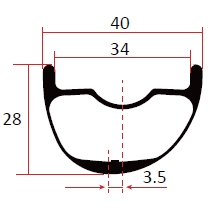
Why T700 Carbon for Mountain Biking?
While higher-modulus fibers like T800 offer higher stiffness-to-weight ratios, T700 carbon is the premier choice for aggressive all-mountain and enduro applications due to several key performance advantages:
- Enhanced Impact Resistance: T700 features higher ultimate elongation and toughness, allowing the rim to flex and absorb heavy rock strikes and blunt impacts without catastrophically fracturing.
- Vibration Damping: The material profile delivers superior compliance, translating to reduced trail chatter, less rider fatigue, and better tracking through rough, technical sections.
- Optimal Durability-to-Weight Balance: It provides the structural robustness needed for gravity riding without adding unnecessary mass, ensuring a resilient wheelset that stands up to seasons of abuse.
The Marketing Myth of the 4mm Flange: Why a 3mm Carbon Rim is Actually Stronger for Your E-Bike or Downhill Build
If you are configuring a custom wheelset for a heavy-duty downhill rig, freeride bike, or high-torque e-MTB, you have probably noticed a major trend dominating new carbon rims: the 4mm wide hookless flange.
On paper, it sounds like common sense. Marketing copy tells you that a wider, chunkier 4mm top edge acts like a blunt anvil, protecting your aggressive 2.5”+ tyres from pinch flats (snakebites) and making the rim indestructible.
The Reality Check: We look at how carbon is actually made in the factory, and how it performs on the trail. Bigger isn't always better. For hard-charging riders who need absolute reliability, a flawlessly manufactured, void-free 3mm carbon flange is a significantly tougher, safer, and better-performing rim than a bloated 4mm design.
Here is why a precision-engineered 3mm carbon rim defeats the 4mm hype in real-world trail conditions.
1. The Hidden Factory Defect: Internal Voids
Carbon fibre gets its incredible strength when layers of carbon sheets are compressed tightly together with zero air trapped between them. To create a 4mm wide edge, a factory has to stack dozens of extra carbon layers at the top edge of the rim, and then abruptly drop them off to connect to a standard 1.2mm thin sidewall. This creates a steep internal "step."
- The 4mm Reality: Carbon sheets are naturally stiff—they do not like to bend tightly around sharp, steep steps. When draped over a 4mm block, the carbon sheets bridge across the gap, leaving hidden microscopic pockets of trapped air and unreinforced, brittle resin.
- The 3mm Advantage: A 3mm flange requires much less material to be shed. The factory can taper the layers down gradually and smoothly. This allows the carbon sheets to lay perfectly flat, ensuring a dense, flawless structure with zero hidden weak spots.
2. The "Anvil Effect" and Cracked Sidewalls
A high-performance carbon wheel needs a balance of lateral stiffness and engineered vertical flex to absorb harsh trail chatter and hard rock strikes.
- The 4mm Reality: A solid 4mm block of carbon is completely rigid and unyielding. When a heavy rear wheel slams into a square-edged rock, the 4mm edge acts like a physical anvil. Because it won't flex, it transfers 100% of that violent impact force directly into the thin sidewall right below it. This sharp transition point becomes a severe stress riser, often causing the rim to crack horizontally or delaminate right below the tyre bead.
- The 3mm Advantage: A 3mm flange retains a healthy degree of proportional compliance. It is incredibly tough against vertical hits, but it works with the sidewall instead of against it. When you smash a rock, the impact energy flows smoothly down the entire face of the rim profile and dissipates safely across the whole structure.
3. Lower Unsprung Weight Means Superior Suspension Tracking
In mountain bike suspension physics, weight at the furthest edge of your wheel is called unsprung rotational mass. Extra weight here is absolute poison for your rear shock's performance. Switching from a heavy alloy hoop or a bulky 4mm carbon design down to an optimized 3mm carbon rim saves roughly 150g to 200g of pure rotational weight per wheelset.
- Better Tracking: A heavy wheel has too much kinetic inertia. When you smash through high-speed braking bumps or jagged rock gardens, a heavy wheel wants to keep floating upward, overloading your shock's rebound. A lighter 3mm carbon rim drops your unsprung rate, allowing your suspension to react instantly and snap your tyre back down into the dirt for maximum braking and cornering grip.
- More Agility: A heavy rim acts like a giant spinning flywheel, making the bike feel sluggish and exhausting to lean into corners. A 3mm carbon rim eliminates that heavy gyroscopic drag, making your e-bike feel agile, playful, and eager to change lines instantly.
4. Your Tyre Insert Already Solved the Pinch Flat Problem
The number-one reason brands push a 4mm flange is to prevent pinch flats on big tyres. But let's be honest: if you are riding an aggressive downhill e-bike or gravity rig, you aren't relying on bare rim geometry to save your tyres. You are running a high-quality dual-ply casing tyre paired with a premium foam tyre cushion (insert) like CushCore.
The foam insert takes up air volume and acts as a progressive bump-stop. On a violent bottom-out, your tyre tread hits the dense foam cushion before it can ever be mashed flat against the raw carbon edge.
Because the tyre insert completely handles pinch-flat protection and mechanically locks your tyre bead into place, the 4mm flange loses its only real-world purpose. You are left carrying a heavy, rigid rim with higher risks of factory flaws, trying to solve a problem that your tyre insert has already completely fixed.